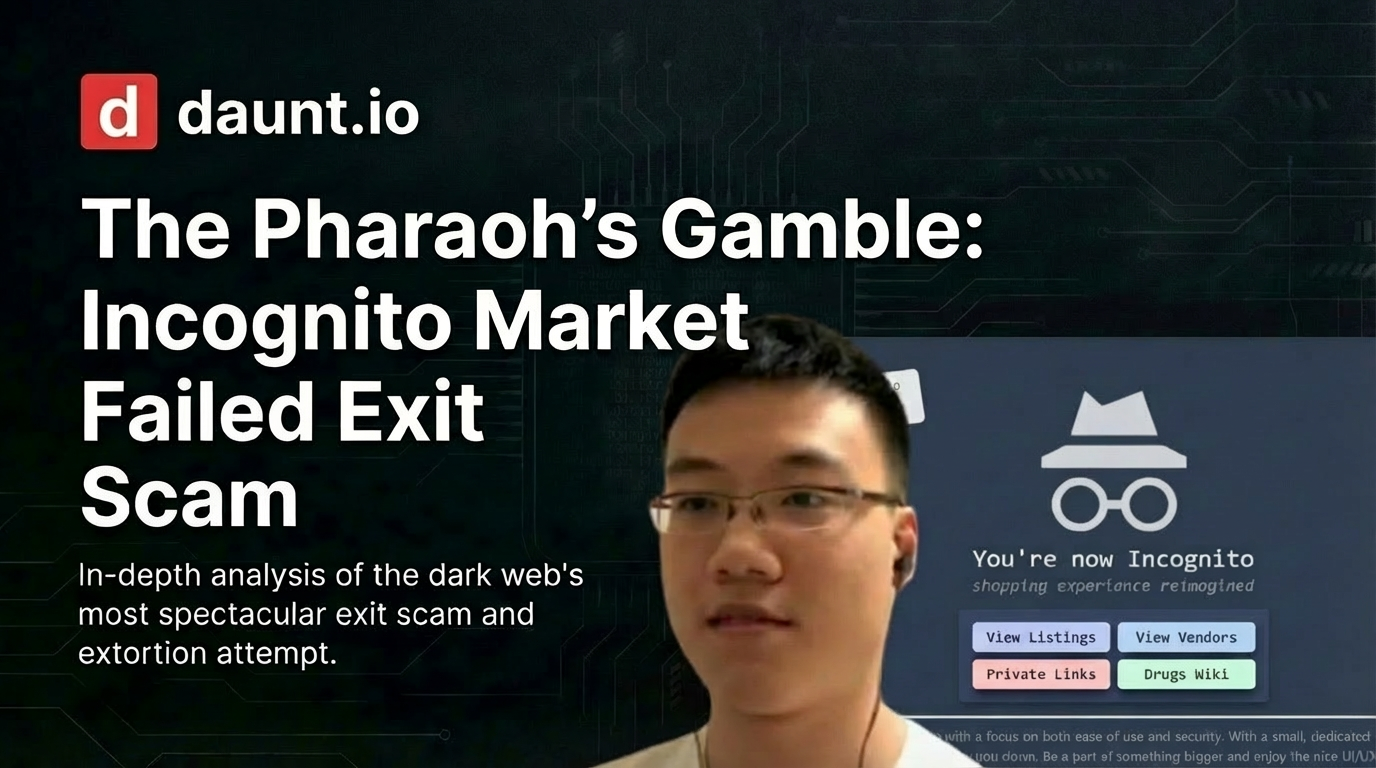
Introduction: The Double-Cross
In the clandestine history of the dark web, the 'exit scam' is a tired cliché: a marketplace administrator abruptly freezes withdrawals, siphons millions in user cryptocurrency, and vanishes into the digital ether. It is a calculated, quiet betrayal. But in March 2024, Rui-Siang Lin, the 23-year-old Taiwanese administrator of Incognito Market known as 'Pharoah', decided that theft was not enough. Driven by a staggering cocktail of greed and hubris, he attempted to double-cross an already defrauded community, orchestrating a mass extortion campaign that transformed a standard financial crime into a spectacular operational suicide.
The Setup: A $100 Million Empire
Incognito Market had been a reliable staple of the darknet since October 2020, moving over $100 million in narcotics. By early 2024, Lin appeared ready to cash out. In early March, users began reporting issues withdrawing Bitcoin and Monero. This was the classic signal of an exit scam; the trust was broken, the money was gone, and historically, this is the moment the operator ghosts the server.
The Pivot: Greed Over Survival

Instead of disappearing, Lin updated the Incognito homepage with a brazen, almost taunting ultimatum. 'Yes, this is an extortion,' the message read, stripped of any pretense. 'We have accumulated a list of private messages, transaction info and order details over the years. You’ll be surprised at the number of people that relied on our ‘auto-encrypt’ functionality.'
Lin demanded ransom payments ranging from $100 to $20,000 depending on the vendor's size. Failure to pay by May would result in the publication of 557,000 order records and 862,000 transaction IDs to law enforcement.
Security analysts watched in disbelief. Lin had already successfully stolen the marketplace liquidity. By launching an extortion campaign, he committed a cardinal sin of criminal tradecraft: he extended his exposure time. Instead of disappearing with his illicit fortune, he remained online, antagonizing thousands of criminals and generating fresh network traffic for federal investigators to analyze. It was a 'double-dip' strategy that reeked of arrogance rather than necessity.
The Irony: The 'Expert' Who Failed
The depth of Lin’s miscalculation is magnified by his professional background. In a twist of profound irony, court documents revealed that Lin had previously worked for the Taiwanese Ministry of Foreign Affairs. His role? Training law enforcement officers in blockchain analytics.
The man threatening to expose users for poor operational security (OpSec) was, in his daylight life, teaching police how to catch people like himself. He seemingly believed his understanding of trace analysis made him invincible. In his extortion note, he mocked his users: 'I guess nobody never slipped up.' Yet, federal complaints allege that Lin used a centralized exchange account verified with his real government ID to fund the market's early infrastructure.
The Final Blunder: Flight to JFK

If the extortion was a strategic error, Lin’s travel itinerary was a failure of survival instinct. On May 18, 2024—just weeks after poking the collective eye of the FBI, HSI, and thousands of angry drug dealers—Lin boarded a flight to the United States. It remains unclear why a man sitting on a stolen fortune and actively engaging in high-stakes federal blackmail would voluntarily enter the jurisdiction of his primary pursuers. He was arrested by Homeland Security Investigations (HSI) agents upon arrival at JFK Airport.
Conclusion: A Monument to Hubris
Rui-Siang Lin’s downfall was not the result of a zero-day exploit or a sophisticated undercover sting. It was a collapse engineered by his own ego. He had won the game; he had the money. But the compulsion to humiliate his users and extract every last cent turned a getaway into a trap. In the end, the 'Pharoah' did not build a dynasty. He built a perfectly observable cage, locked himself inside, and then flew across the ocean to hand over the key.
Case References
Factual data sourced from federal indictments and security reporting.
- US Dept of Justice: Complaint against Rui-Siang Lin (Case 1:24-mj-04137)
- Krebs on Security: Incognito Darknet Market Mass-Extorts Buyers, Sellers
- Wired Magazine: 'He Trained Cops to Fight Crypto Crime'
- Leafie: 'Incognito: The darknet market that stole everyone’s money'